Nullam dignissim, ante scelerisque the is euismod fermentum odio sem semper the is erat, a feugiat leo urna eget eros. Duis Aenean a imperdiet risus.
Nullam dignissim, ante scelerisque the is euismod fermentum odio sem semper the is erat, a feugiat leo urna eget eros. Duis Aenean a imperdiet risus.
 author
A powder coating oven achieves consistent curing when temperature uniformity, airflow, dwell time, and loading pattern match the part and powder formulation. A setpoint alone is not enough: cold zones, uneven circulation, crowded racks, or a poor match between conveyor speed and heat transfer can leave one area under-cured while another is over-baked. The practical answer is to select an oven around the real production flow and control the thermal conditions each workpiece experiences.
For metal finishers, Colin‘s powder coating oven solutions are most useful when they are treated as part of the entire finishing process rather than as an isolated heat chamber. The oven must work with the powder chemistry, part geometry, pretreatment quality, spraying method, and material movement that come before it.

A temperature reading from the controller is a process reference and no indication that all parts have reached the same metal temperature. The thickness of brackets, hollow tubes, edged components, and lightweight sheet-metal enclosures will each affect their rate of heat absorption and dissipation; therefore, identical oven air conditions may yield different cures.
A sound curing plan considers heat-up time, time at the required cure condition, and the way parts are arranged on the rack or conveyor. Colin powder coating ovens offer a temperature range of +10 C to 300 C, with options up to 400 C, and temperature-uniformity options of +/-5 C or +/-3 C.
Hot-air circulation matters because stable curing depends on more than making the chamber hot. Air must move around the load without creating sheltered areas behind tightly packed parts, deep channels, or oversized fixtures. Full-convection circulation and multi-zone control help reduce the difference between the hottest and coolest positions in a working load.
Loading discipline is equally important. Leaving sensible clearance between parts, keeping return-air paths open, and avoiding a mix of unusually heavy and light items in the same tightly controlled recipe make the oven easier to manage from shift to shift.

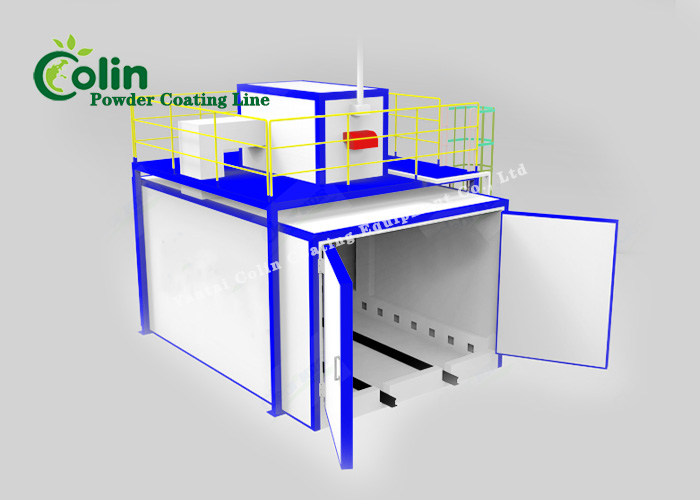
A batch powder coating oven is a practical choice when the workpiece mix changes often, parts are large, or individual loads need different handling. Large construction components, customized profiles, and varied fabrications benefit from the access, loading flexibility, and size customization associated with a batch layout.
The tradeoff is that consistency relies heavily on repeatable loading and a disciplined cure recipe. Teams should define rack positions, maximum load density, and practical spacing before treating a batch cycle as a production standard.
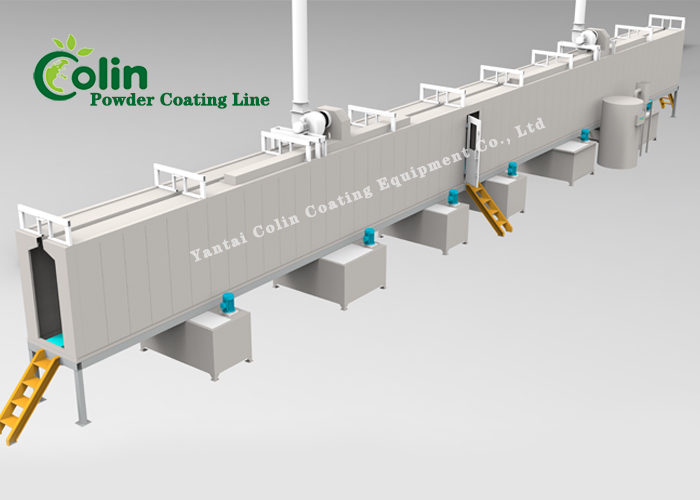
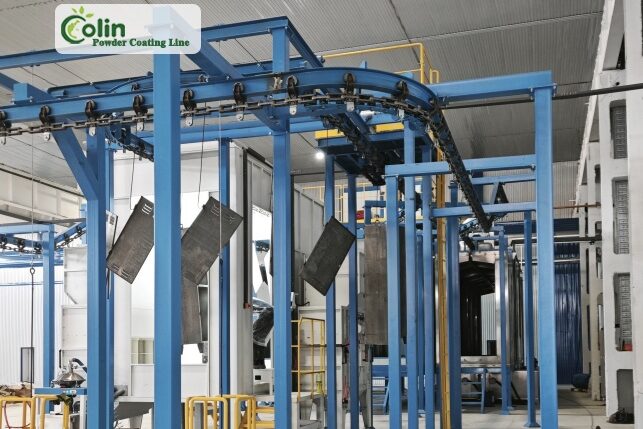
A hanging line with a conveyor or tunnel powder coating oven would be preferable for continuous and uniform production since such an approach would provide a consistent and predictable process where all elements of the line are interconnected, including the speed of the chain, the length of the oven, the airflow, etc.
The key is not simply continuous movement. The coating team must verify that the selected speed gives each part enough time to heat through and cure, even when product mix, hanger density, or ambient conditions change.

Electric heat, gas, diesel, and biomass pellets provide a variety of methods for matching the oven to site utilities and conditions. Selection is determined by the site infrastructure, energy availability, ventilation needs, environmental constraints, control method desired, and required heating profile of the coating process.
Insulation is one of the factors to consider when making a decision, as insulation impacts the efficiency of the oven and stability of the working environment around the chamber. Colin provides rock wool, glass wool, and ceramic fiber insulation options and galvanized sheet or stainless steel inner liner materials. The selection of material type is dictated by the operating temperature and cleaning of the furnace.
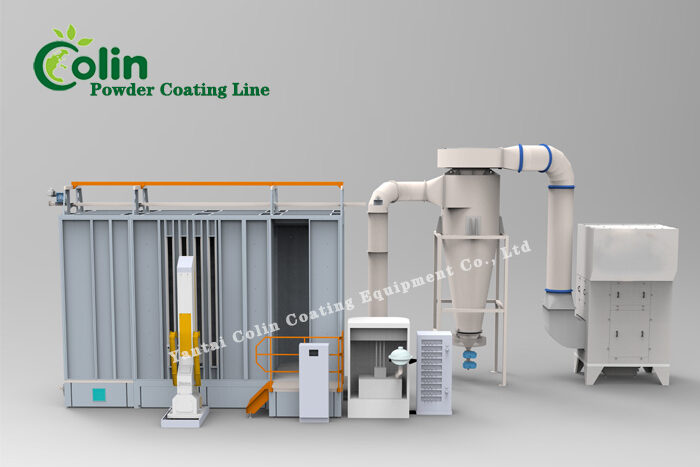
Drying and curing solve different problems. After washing, phosphating, or ceramicization, a drying oven removes remaining moisture so the powder application stage begins with a clean, dry surface. After electrostatic spraying, a curing oven melts, levels, and cross-links the powder into its final film.
Combining these stages carelessly can complicate defect analysis. When blistering, poor adhesion, or uneven appearance occurs, separating the questions of substrate dryness, powder application, and cure conditions makes corrective action much more precise.
A powder coating oven cannot compensate for oil, residue, moisture, weak powder coverage, or unstable part presentation. Pretreatment must produce a clean surface, the booth must provide even application, and the conveyor must keep the part at a predictable orientation before it reaches the cure zone.
That connection is why custom coating solutions are most effective when engineers consider the route from loading through cooling. The oven is where upstream process decisions become visible in the final finish, making it an essential checkpoint for both appearance and durability.
Before settling on an oven configuration, define the material, largest and smallest dimensions, weight, wall thickness, shape complexity, expected production rhythm, and coating requirement. These details shape the useful furnace size, heating method, loading arrangement, conveyor relationship, and control approach much more accurately than a generic capacity figure.
Colin can tailor oven parameters and line integration around those conditions, including working-temperature needs, heating time, effective furnace dimensions, and the workpiece range. This approach gives a mixed-production workshop and a continuous finishing line different but equally practical paths to stable curing.
A well-chosen powder coating oven creates more than heat: it creates repeatable thermal conditions for the full load, supports a controlled production rhythm, and protects the finish from avoidable curing variation. Temperature uniformity, airflow, oven type, energy choice, insulation, and loading method all need to reinforce one another.
When the oven is matched to the workpiece and connected to the rest of the line, metal finishers can pursue consistent coating performance without treating cure quality as a last-minute adjustment.
Talk with Colin about an oven layout that fits your metal-finishing process.
A: The right temperature depends on the powder supplier’s specified cure schedule and the metal temperature reached by the actual workpiece. Colin ovens cover +10 C to 300 C, with options up to 400 C, but the selected operating point must account for material thickness, load density, airflow, and time at temperature rather than relying on air temperature alone.
A: A batch oven suits varied loads, large parts, and flexible production because workpieces can be loaded and cured by cycle. A conveyor oven suits stable, repeating output because chain speed, oven length, and part spacing can be coordinated. The better option depends on workpiece variety, throughput rhythm, and handling method.
A: Temperature uniformity helps parts in different positions receive similar thermal conditions. Without it, a thick component or a sheltered location may heat more slowly than a light, exposed panel, creating inconsistent film development. Uniformity works best alongside open airflow paths, sensible rack spacing, and a cure recipe based on actual metal temperature.
A: One configuration may serve both only when the loading method, cure profile, and airflow can accommodate their different thermal behavior. Aluminum profiles often heat quickly, while heavy steel parts retain heat and need more energy to reach the same condition. Separate recipes, spacing rules, or oven zones may be needed for dependable results.